
Franklin County Blotter Source Map
The Franklin County Sheriff's own site posts no set arrest log. There is no 72-hour list, no seven-day count, no weekly booking roster with names and photos. The county's media releases and meeting documents track other business entirely. Facebook posts cover selected incidents. Monthly public-safety attachments tally activity in bulk. None of it adds up to a searchable booking archive, and none carries a stated retention window for Franklin County arrest records.
A multi-day search needs three layers. Official sheriff and county documents come first. Dated local news that credits an agency comes second. Commercial county pages sit last, flagged as secondary at best. Keep one more caution in mind. Silence in the blotter does not mean no one was arrested, and an old arrest story says nothing about who sits in custody today.
Read Franklin County Arrest Reports
A good blotter search runs from the record date backward. Start with when an arrest report was written and which agency wrote it. The face and the charge label come last, never first.
- Set the event period and note whether it includes a weekend or holiday.
- Check the sheriff’s media-release route and county meeting documents for an official report dated within or after that period.
- Search local outlets by agency and date. Preserve the outlet, publication date, stated arrest date, and source attribution.
- Contact the arresting police department for its incident report and the sheriff/jail for a county booking record.
- Check the Circuit Clerk’s docket for the filed charge and later disposition. Do not treat the booking charge as the case outcome.
Need only the newest custody answer? Use the 24 Hour Arrests process instead. That route leans on the jail contact and processing lag, while this Franklin County log gathers reports that stack up over days or months.
Franklin County Log Entry Fields
Franklin County has no single log template. So capture these fields from any dated release or request. That keeps arrest items from separate sources from being merged by mistake.
| Field | Why it matters |
|---|---|
| Outlet and source agency | Separates an official release from a newsroom summary or copied listing. |
| Publication and event dates | Shows whether the report was delayed or retrospective. |
| Name or booking identifier | Helps distinguish people with similar names without relying on a photo. |
| Arresting agency | Identifies the likely custodian of the incident report. |
| Booked charge | Records the charge at that stage, not a conviction. |
| Custody destination | Shows whether county jail, another facility, or release was reported. |
| Photo credit | Distinguishes an agency or news image from a verified booking photograph. |
Some Franklin County stories omit a booking number or bond. Never fill those gaps with data pulled from a person who merely shares the name.
Weekend Reports and Publication Gaps
Franklin County posts no official weekend refresh rule. A Friday arrest still gets booked by the jail, but the press release or court entry may trail behind. Holidays create the same lag. Delayed publication does not mean delayed booking. The jail, the newsroom, and the courts each keep their own work cycles.
Illinois law sets a different clock. Under the 5 ILCS 140/2.15 standard, certain arrest information must reach news media as soon as practicable, and no later than 72 hours, subject to exceptions. That statute builds no rolling public webpage. It also promises no booking photo in every Franklin County case.
Monthly Franklin County Jail Reports
Monthly attachments from county public safety add official context. June 2024 lists 153 jail intakes and an average daily population of 69. July climbs to 178 intakes and an average of 80. August shows 166 and 74. October shows 140 and 70. March 2025 reports 189 intakes plus a patrol total of 63 arrests. April drops to 158 intakes and 42 patrol arrests.
None of this is a name-level arrest log. Intake, patrol arrest, and average daily population count different events, since an intake can be a hold, a transfer, or a release and rebooking, while the patrol figure covers only that reporting unit's work. A handful of monthly totals cannot support a crime-trend claim.
Some months also break out juvenile counts. A count never makes a juvenile's identity or booking photo public, and it should not anchor any juvenile arrest listing.
Franklin County News Blotter Pattern
Franklin County News keeps a local archive, and its older posts reproduce sheriff reports. WEBQ has carried a dated sheriff report. US977 has run Benton Police material. WMIX, KBSI, KFVS, and the Daily Register add event coverage, but this stays a sporadic newsroom layer rather than an official jail feed.
Dated local coverage lives in the category view, though its story picks can't tell you how many people actually entered custody in Franklin County.
One example is this Franklin County sheriff-report story, which follows a retrospective format.
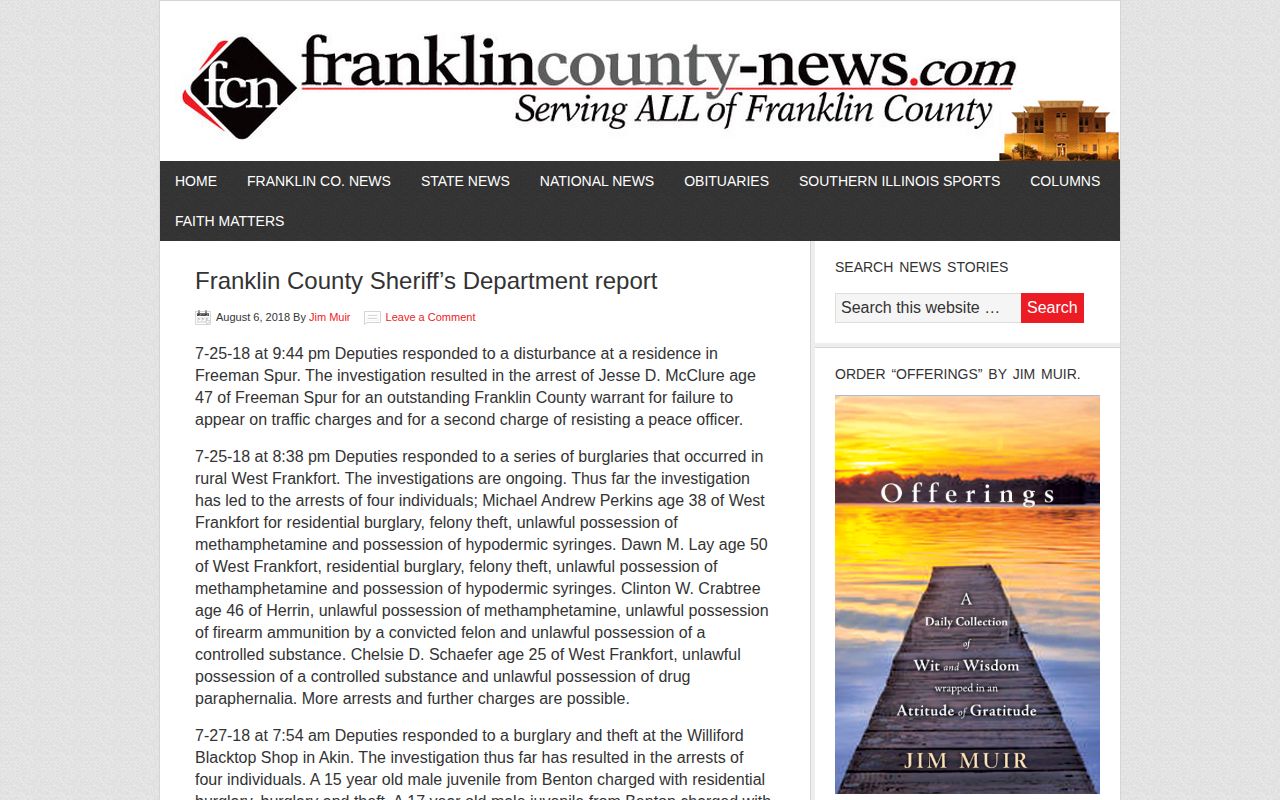
Any fact pulled from that page needs its date and agency attribution kept close. The story is old, not a live roster. A different example appears in the WEBQ Franklin County Sheriff's Report, where a local radio station distributes an agency report.
The WEBQ piece is a dated repost from a secondary outlet. So treat it as background on the sheriff's arrest activity, not as a current custody source.
Older Franklin County Arrest Records
Old posts do not last forever, so go back to whoever made the record in the first place. A city police department keeps its own incident files. Booking material for county arrests sits with the Franklin County Sheriff/Jail. Court cases belong to the Circuit Clerk. The county Transparency page spells out the sheriff's FOIA route through Dava Vice at 403 E. Main Street in Benton.
Illinois FOIA gives an office five business days to respond, and it can claim a five-day extension for stated reasons. That clock does not mean instant copies. Narrow your date range, ask for electronic delivery, and request the releasable portion if something gets withheld. The county posts no retention term for booking sheets or digital photos. Ask for the approved retention schedule instead of guessing.
Really old arrest records take an archival turn. The Illinois State Archives catalog lists Franklin County jail registers from 1874 through 1955. Criminal court series reach into the twentieth century. Treat these as historical collections rather than a current arrest feed or mugshot source.
Secondary Franklin County Log Limits
Commercial arrest sites can keep an entry alive long after the news moves on. Everything on them is a copy. Their counts, update labels, booking fields, and photos carry no county authority. RecentlyBooked runs a visible Franklin County section. Mugshots.com has a county category. Busted Newspaper pages exist too, though no stable Franklin landing page does. None of them should sit at the front of a record search.
Skip combining their tallies with monthly sheriff numbers. The time windows differ, the units differ, and duplicates or later fixes often linger. An entry works only as a clue. It points you toward the real sheriff booking record and the court outcome. A photo gallery has no place in a responsible blotter treatment either.
Franklin County Arrest Outcomes
A Franklin County arrest is only the first step. News reports freeze the charge on the day it prints. The case can end many ways after that. Dismissal, acquittal, a plea, conviction, or supervision all show up in court records, which keep moving long after the arrest log goes quiet.
Checking outcomes takes the right tool. The Franklin County Circuit Clerk offers a public-access computer at the office, plus a link to DocketVision for searching dockets. Remote searches have limits, though. Sealed, secured, juvenile, and archived files may not appear online, so confirm a final result with the clerk and check custody status with the jail.